
Around six-to-eight million years ago humans and chimpanzees went their own ways. Before that we were one of the same and even now apes remain our genetically close cousins.
Much closer than dogs and wolves. It’s that close promixity to how similar are which provides the backbone of the drama in the Planet Of The Apes series, which suggests that with just a little evolutionary push — in this case the man-made drug which makes the chimp Caesar (Andy Serkis) and his comrades super-intelligent — chimps, bonobos, orangutans and gorillas could topple our species one day.
“Genetically speaking there is very little difference between us,” confirms Dr. Zanna Clay, Assistant Professor in the University of Durham’s Psychology Department and a leading specialist in chimpanzee and bonobo behaviour. “Chimpanzees and bonobos are our closest living relatives, with gorillas and orangutans marginally less closely related to us.” Having worked with chimps and bonobos in both the wild and in captivity, Clay believes that by studying these two ape species, we can achieve, as she puts it, “the best view of what we could have looked like before we became human,” and learn about our own evolution.
So how close are we, and what advantages might chimpanzees (and their sister species the bonobo) have over us? Could they really one day replace us as the dominant species on Earth? Together with Dr. Lauren Brent, a primate behavioural ecologist from the University of Exeter, Clay takes us through a Human V. Ape comparison — with some rather surprising revelations…
PHYSICALITY
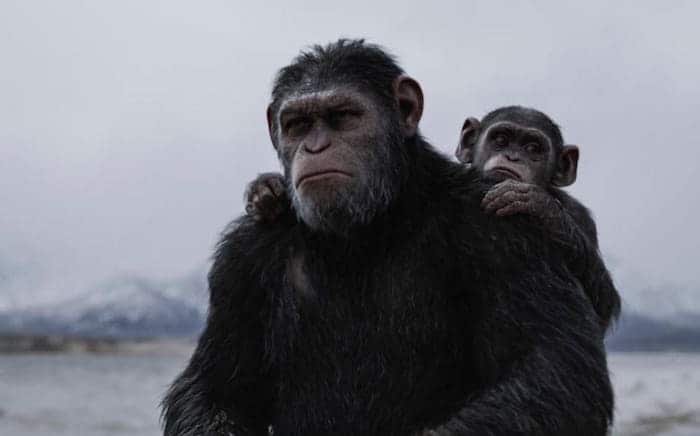
In a straight-up, one-on-one physical confrontation, there’s no contest between human and chimp. “They are five times the strength of humans,” says Clay. “They’re like gymnasts who work out all day; their athletic capacities are amazing.”
Dr. Lauren Brent remembers the story of a colleague who got a little too close to the chimpanzee Frodo in the Kasakela Community in Tanzania (made famous by renown primatologist Jane Goodall). “Frodo climbed out of the tree where he was eating, walked up to my colleague, pulled his feet out from under him and dragged him around for a little bit,” says Brent. “And he’s six-two or something. Not a small guy!”
Chimps also have some rather sharp teeth. “In the film they have all these guns, but in chimpanzee aggression it’s really teeth and beating,” says Clay. “They can be pretty brutal.”
However, they are somewhat restricted by their short legs — even bonobos which have longer legs than chimps and are more bipedal. “They don’t run very much and they can’t run far,” says Clay. “They can’t run a long distance like we can. They’re just not physically geared up for it. They’re mostly climbers.”
TECHNOLOGY

It seems like technology would be a no brainer. Even in the movie the fight scenes pit guns, missles, grenades and more against sticks and strength. A very modern soldier Vs caveman scenario. but chimpanzees don’t have technology, or do they?
“They do have what we call percussive technology, which involves using stone tools to hit things. So they have hammers and anvils, which they use to crack nuts. And some of them use sticks which they dip in holes in the ground to extract stuff, like ants.” Some chimpanzee communities even use spears, she reveals. “They actually do spear-hunting; they cut sticks and use them to hunt live prey. So aside from humans, they’re the world’s best tool-users.”
Yet what chimpanzee can’t do is improve on their inventions like humans do; they don’t have what’s known as cumulative culture. “So basically they’ll reinvent the same thing over and over again,” Clay explains. “A chimp might invent spear fishing, but they won’t build on it to make, over generations, a better version of the spear.”
COMMUNICATION

This is where humanity is the biggest winner, it seems. “We cooperate on a scale that no animal that we know of can,” says Brent. “And that is largely down to our ability to communicate with each other.”
There’s no sign language apes out there. That’s why Caesar’s apes do so well in their army, because they can quietly communicate through sign language.
Real chimpanzees do have their own, limited form of language, though. “In the sense that they can combine things together and produce meaningful sounds,” qualifies Clay. “The way apes use vocalisations shows hints of language, and is really well adapted to the conditions they live in. But it’s not a full-blown language. They have components of language, but they’re just not all connected as a whole. For example, we know they can combine calls together and the sum of the sequence can change the meaning of the parts, but humans can combine and reorganize sounds into infinite different meanings and words. Apes are not able to do that.”
SOCIETY
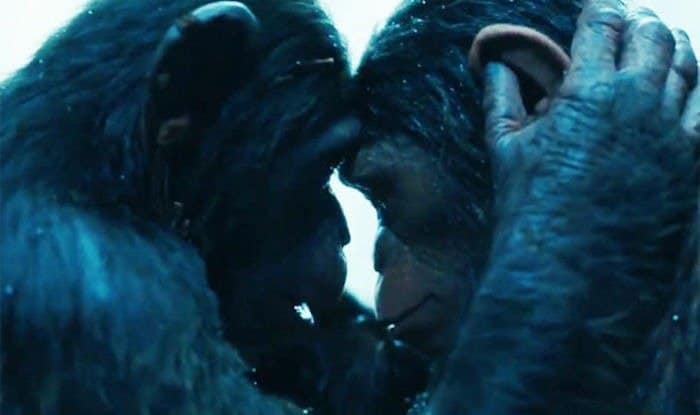
One aspect of War For Planet Of The Apes that impresses both Clay and Brent is the way it portrays Caesar’s ape society. “In terms of the warfare, with all these different chimps going off in little parties and coming back to the main group, that’s very much what chimps do all the time,” says Brent. “They go on patrols, little parties break off to forage, and then every few days they’ll come back together as one big population, which is run by one alpha male. I think a lot of the big-scale societal stuff in the films is fairly spot on.”
The key difference, she points out, is that unlike the films’ advanced apes, chimpanzees are not monogamous. Indeed, female chimps are often treated very badly — “it’s not very nice to be a female chimp,” says Brent. They are also, as Clay put it, “very xenophobic”, so they wouldn’t welcome in orangutans, gorillas, or even chimps from other communities. “But bonobos might be better at it,” Clay suggests. “There’s experimental and behavioural evidence that they quite like interacting with strangers.”
Gorillas, she explains, “have a harem society where you have one silverback who controls all the females, who don’t really socialize with each other.” Orangutans, meanwhile, “are kind of semi-solitary, so they have quite mysterious societies,” and in bonobo society, “it’s actually females who dominate.” The closest human equivalent to the way chimpanzees organize themselves, Clay thinks, is the Mafia. “It’s a bit like in gangster films. They have a very strict male hierarchy. You’ve got this key male, and then you’ve got all his friends who are trying to be close to the top. They’re really close, they’re good buddies, but they’re all after power. And they’re really against outsiders.”
But while ape colonies can number in their hundreds, they could never socially organize on the scale that humans do. “We can cooperate on a huge scale, in a very extended, elaborate way,” says Clay. “Chimps cannot do that.”
ADAPTABILITY
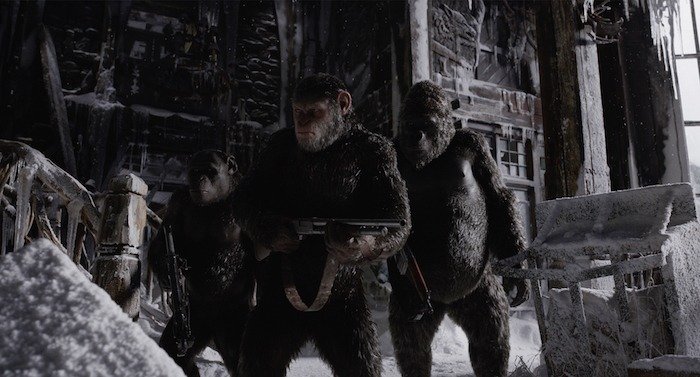
Even if human society were to collapse tomorrow, or be eradicated by a global pandemic as in the Planet Of The Apes films, it’s unlikely that chimpanzees would rise up to replace us. “They’re quite ecologically and geographically restricted,” Brent points out, “so if we’re talking about taking over the Earth as a geographical takeover, then no. They’d be limited to a strip around the middle of the globe.”
“Apes have to stick to the shade,” says Clay. “They hate the sun. You do get some communities where they go out more in deserts, but we have colonised the whole planet. We can get around and move around so easily. Whereas chimps are pretty restricted to living in the rainforest.”
That said, it has been observed that chimpanzees and bonobos may be undergoing significant advancements as species. “Some people think apes might be going through a bit of a revolution in terms of their cultural and tool-use development,” reveals Clay. “They think they’re using more tools at the moment than they have done before, and that they’re hunting more.” Of course, she warns, it may just simply be the case that “they had been doing that before and we didn’t know.” Still, she does point out that “chimps are learning to adapt in the human-oriented environment,” — i.e. in captivity, like the Caesar in Rise of the Planet Of The Apes. Whether that’s going to have any long-term effect on the species remains to be seen, but it could be that humanity’s closest living relatives may yet come even closer.
Pre Order War For The Planet of the Apes today