New shark movies and the shark genre as a whole is a rarely discussed subject in cinema. Samuel Edwards hopes to change that in this very article!

Audiences have usually dismissed this quality of the genre ever since Jaws (1975) hit screens. This is thanks to the awful Sharknado franchise and countless others.
In order to find out how to get the shark genre right, I would like to place Die Hard 2 director Renny Harlin’s Deep Blue Sea as part of my central debate.
I believe the film was a fairly noble attempt of make an exciting shark film, although still at B film quality.
With this, I hope to understand the genre and more importantly know how to get it right through the discussion of its characters and practical effects.
Context
Jaws (1975) is not only the best shark film but it is one of the greatest films ever made with much more substance compared to the new shark movies we see today.
It works for several reasons, such as the soundtrack, the use of practical effects but most importantly I think it’s the characters that stay with you throughout the ride.
It’s the three main leads that form such a complimentary trio that of Brody, Quint and Hooper, even more so than the wolfpack from the hangover trilogy and that’s saying something.
Therefore, its success comes down to its characters and its use of practical effects.
The shark was a mechanical model which was as realistic as you can get in cinematic forms. It’s that attention to detail that frightens audiences the most.
To add to this, Jaws 2 being both unnecessary and inevitable works when we learn of Chief Brody’s downfall as a cop because we have come to admire him from his heroic acts in the first film. It’s crucial that we can at least be invested in these characters.
In modern day cinema, several straight to DVD shark films are produced and its actually rare that we find a cinematic released shark film that’s actually good.
This shows the little hope that producers have in this genre.

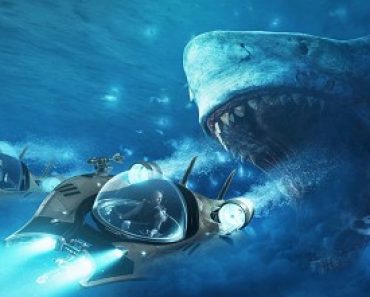
In that selection, we can discuss The Meg, The Shallows and Open Water. I enjoyed The Meg and The Shallows, however, those films included a shark that was too big to be believable and heavy use of CGI which ultimately leads to B film experience, which failed to grab my believability.
Open Water on the other hand had a terrifying premise but was executed on a student film like budget.
This concludes that the more use of practical effects on the shark, the better. For example, in Deep Blue Sea, although there are many shots where you can tell the shark is completely CGI, however we get some glorious glimpses of a practical shark.
The shark is designed to look realistic. Its piercing black eyes and razor-sharp teeth gives a menacing impression.
Deep Blue Sea/Characters/Themes/Practicality
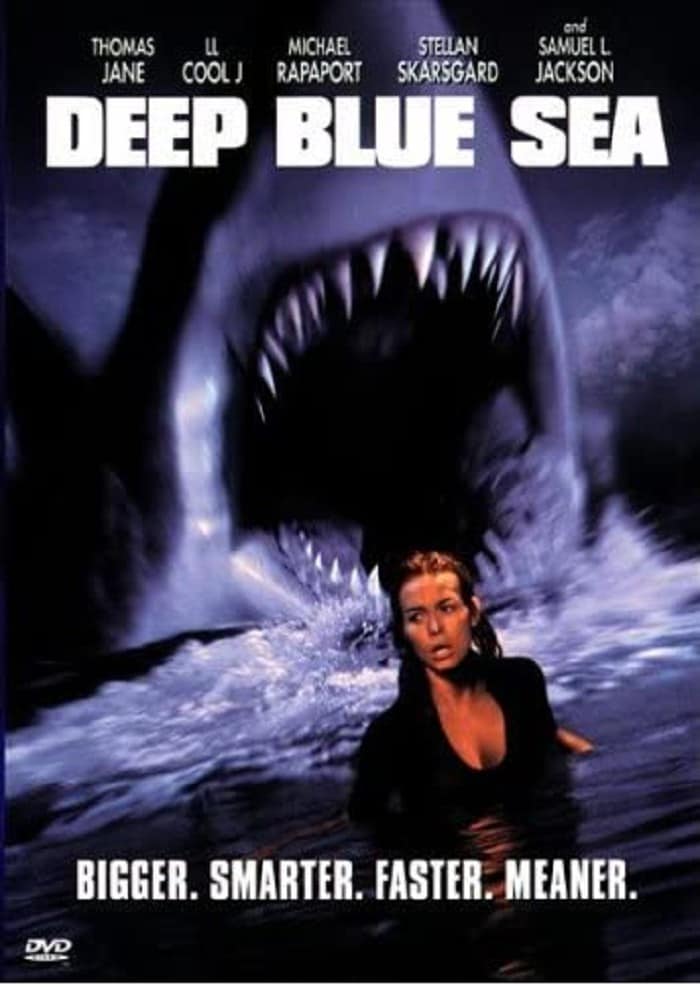
Deep Blue Sea (1999) follows a team of scientists who all aim to get rid of Alzheimer’s disease. They do this through research on Mako sharks. When several mako sharks break into the facility. Their aim shifts to survival.
The cast includes, Thomas Jane, Saffron Burrows, Samuel l Jackson, Stellan Skarsgard, LL Cool J and Michael Rapaport. For the most part, this cast works well.
The film’s main leads are Thomas Jane, who does his best John Mcclane impression and Saffron Burrows who plays a cold but intelligent scientist who is the main instigator of the operation.
Some of the standouts include Samuel L jackson and LL Cool J who add humour even when is he thrown into the most terrifying scenarios. He also forms a nice friendship with his parrot and Thomas Jane, making him likeable.
The plot itself is very B film like, however it does contain some interesting motivations. The plot is driven by a will to find a cure for Alzheimer’s disease, which is a theme that all audiences can get behind as it is a very real issue.
It is mentioned that Saffron Burrow’s character, Dr Susan McAlester cares more about the successful implementation of this experiment over the lives of other people.
She redeems herself when she sacrifices her life in the final act. In the similar vein of shark genre plots, this one is sometimes hard to believe due some of the characters blunderous choices but it’s exciting.
It takes ideas from previous shark films but expands them on a grand scale. With this, we not only get glimpses of a practical shark but also shots of real destruction.
When the sharks break the glass, we get one a wide shot with few cuts showcasing the internal destruction. They use a real water tank which adds to the believability.
Unlike several teen slashes, you feel a sense of commodity and real fear with this crew. Whenever one character dies you feel a sense of loss because they do. This results in deaths that do not feel meaningless, which is so important in this genre.
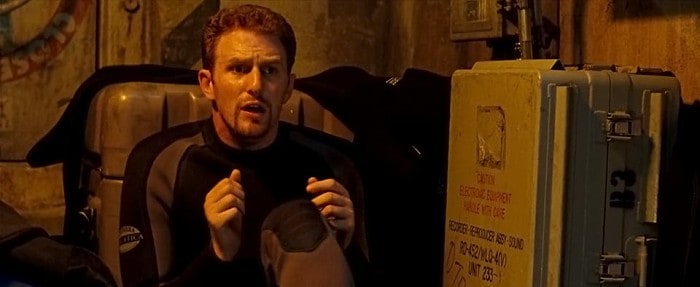
This is shown when Michael Rapaport’s character dies, LL Cool J takes a moment to remember him, giving us a reason to feel invested in him.
They also find themselves in a very terrifying scenario, one that is very hard to escape from, when several mako sharks break the glass of their underwater facility, which results in flooding on almost every department and layer of the infrastructure.
One moment in particular, LL Cool J hides in an oven to escape from the shark only to find the shark turning the oven on by accident.
Although this idea is Ludicrous in several ways, it is still a scary experience to visualize.
John Williams score to Jaws was perfect, however the score composed by Trevor Rabin does shine on a few occasions.
His previous musical compositions include classics such as Armageddon, Con Air, Remember the titans, Bad Boys 2 and Coach Carter. The music to the final act worked very well, the tracks are called Kill Big Shark and Aftermath.
Like I mentioned earlier, there is use of CGI in this film. However, I am a little more forgiving. 1999 was a year where Hollywood was a transitioning into using computer generated effects.
It’s not overdone or done for cartoony effect in new shark movies such as Sharknado or Trailer Park Shark.
At the time, they believed rightly so that these effects were a head of its time and they were going to be a pivotal tool in immersive and expansive storytelling.
At the time, they had little intention of thinking how long these effects could wear off. 1999 saw the significant release of The Phantom Menace which didn’t leave a long-lasting impression on its heavy use of CGI.
Therefore, this emphasizes how important practical effects are, especially in the monster genre as they have long term appeal. Although, using CGI today is an unfortunate trend that several directors find themselves into usually due to low budget limitations.
To conclude, as much praise I can give Deep Blue Sea it is still a good B film. It raises key themes in the debate of how one can understand how to make a memorable shark film.
It does include practical effects, it does have likeable characters and an exciting plot.
From this conclusion and comparisons to the recent releases of new shark movies such as The Meg and The Shallows, the long term success of a shark film is dependent on its use of practical effects and writing memorable and likeable characters.

Hopefully there is still quality left in this genre, one aspect is for certain though which is the Sharknado franchise has to end!
New Shark Movies discussion piece by Samuel Edwards