
Marley Eleven Bury brings us the first of many upcoming episodic reviews for Ratched currently available on Netflix. Here are his thoughts on Ratched Season 1, Episode 1.
Contains Spoilers!
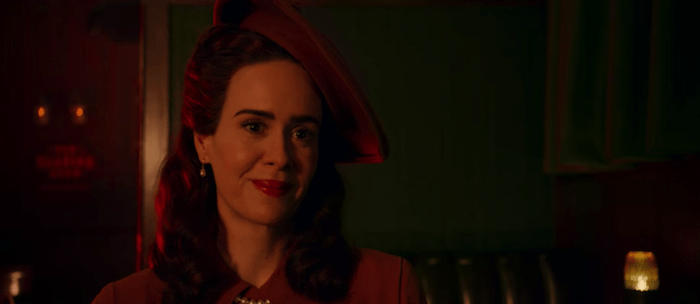
Ratched debuts with an in intriguing setting, mysteries around every corner, vice abound & a despicably brilliant lead character.
One Flew Over the Cuckoo’s Nest is one of the most iconic books & films of all time, so it seems only fitting that a TV prequel series to the novel; exploring the detestable Nurse Mildred Ratched, would be inevitable.
Created by Evan Romansky; a twenty-nine-year-old relatively new talent, developed by Ryan Murphy, the industry-legend behind Glee, American Horror Story and several other TV series.
The old and the new have come together in a fantastic collaboration.
If the rest of the series is as strong as the pilot, then we are truly in for something special.
This series stars Sarah Paulson, Sharon Stone, Finn Wittrock, Judy Davis, Jon Jon Briones, Vincent D’Onofrio and several others in a psychological period-thriller set in 1947, exploring mental health, vice and those who seek to exploit the most vulnerable in society.
The episode opens at church; yet a wolf stalks the lambs, as a masked figure watches the priest return home from the shadows.
Evoking similar period-homage openings, such as the game LA: Noire, this episode then strips away the finery to reveal the ugly truth beneath.
Father McMurtry; our priest from the opening, feigns illness to stay home and pleasure himself with cheap Vaseline and magazines, establishing this episode’s exploration of sex as a dominating vice in many of its character’s lives.
Soon, our killer; Edward Tolleson, finds his way into the home and the massacre begins.
As the other priests return home, the tension draws out like a blade and; perhaps expectedly, the black priest is the next to die, his head smashed brutally against a toilet after finding his fellow priest’s body in his bathtub.
The series pulls no punches with its gore; letting us view the ugliness of death, though it is not over excessive.
Once the third priest falls and the fourth emerges; still not fully aware of the chaos occurring, the series establishes one of its primary colour messaging’s: Green represents sin.
Primarily sexual; though not exclusively, with Father Monsignor wearing a gown of green to represent his crimes of lust.
It is revealed that he impregnated a Catholic Sister and their son; Edward, has now come to seek revenge for the chain of events that led her to overdosing on morphine in a brothel, leaving him abandoned and alone.
The production and costume design reinforces this throughout: McMurtry’s green priest’s ‘Stole’, the room’s carpets and walls largely being green; even the food they eat at the table has bright green peas and a fireplace surrounded by green.
These may be men of the cloth but they are embodiments of pride, lust and greed, to such an extent that the green-shirt the killer Edward wears is actually a less-defined shade than Monsignor’s gown: A commentary on hypocritical cruelty vs. honest brutality.
A single priest survives this assault; hidden beneath the bed, as the series time-jumps six months forward and we are introduced to Nurse Mildred Ratched.
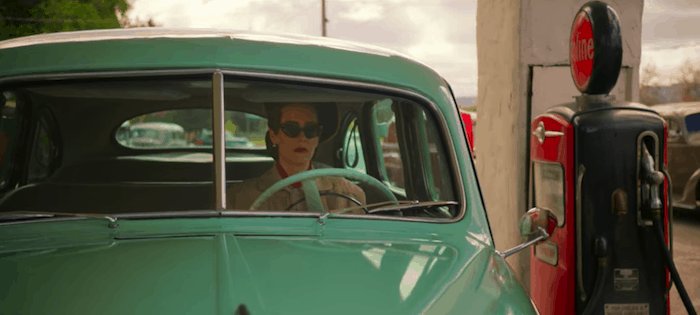
Perhaps most interesting about this scene is the overwhelming presence of turquoise; a blue-green shade, with the ocean waters and even her car being this shade.
A sign of moral complexity or perhaps the idea that she is the corruption of sin, symbolically turning the environment by her nature?
Regardless, we see her stare towards a couple; the girl wearing a green-blouse, kissing affectionately; lustfully, as the camera-closes in on her cold expression.
Interrupted by a gas-station attendant, she comments on his obvious arousal at the couple’s antics and brushes off his attempts at small-talk with disdain, before remarking on his dirty fingernails and driving off.
Immediately, we have established a character who has zero patience for that which she deems unimportant, disgusting or displaying a lack of personal quality.
Her car driving through the sea-side roads; to a gently creepy score by composer Mac Quayle, evokes the imagery of the Shining and we wonder with dread just what is in store for us.
The next several scenes show a plan slowly unfolding and the effort Ratched has gone to to achieve; as of yet, unknown goals.
She has stolen clothing specifically bashed on a fashion trends magazine, she practices her introductions multiple times and; upon arriving at the facility, successfully intimidates the staff and even cranky head-nurse Mrs. Bucket, into tolerating her presence.
Her costume’s rich yellow is appropriate, for she is now clearly to the audience a trap; appearing like honey or a sunflower, yet venomous underneath.
The show truly confirms this when; feigning a need to use the restroom, Ratched instead uses the time to re-apply small gaps in her lipstick, showing her obsessive attention-to-detail.

There, she hears a loud series of noises and finds one of the nurses; Amelia Emerson, who she met earlier, having sex with a patient in a bathroom bathed in green light.
Appropriately, the room this bathroom is in was shown to be called ‘The Vineroom’; as that nurse has now been ensnared.
As Nurse Ratched walks away; exiting into the hallway, the music score ramps up and for a second, you wonder why.
Then, the scene’s lighting and colour grading completely shifts, bathing the entire hallway and Mildred Ratched completely in the same green light of the bathroom.
There, the truth hits you. Her outfits, her disguises, whether they be red gloves, yellow dresses or even her eventual blue nurse uniform, cannot hide her true nature: She is the living, breathing embodiment of malicious intent, sexual manipulation and cruelty in this show; all of which is conveyed in a masterstroke of visual storytelling.
Not a word is spoken, yet the truth is obvious and horrifying.
It is perhaps the most exceptional televisual lighting and colour grading, since the extraordinary production values of HBO’s Euphoria.
Meanwhile, the head of Lucia State Hospital has struggled to secure funding from Governor George Wilburn; played by Vincent D’Onofrio, yet finds a lifeline in his enigmatic wife who seeks to reinvent her husband’s image; potentially with a scheme of her own.
This is in-fact the episode’s biggest strength: From just a look, a smile or a few words, conspiracies are established; wheels within wheels turn in the background, with more than half a dozen minor characters in just the episode so-far, potentially having games of their own.
Some are simple; trappings of lust and desire, like the priests or exposed nurse.
Yet some are clearly far deeper and chasing these mysteries is like tearing at a thread; a dozen more open up around it.
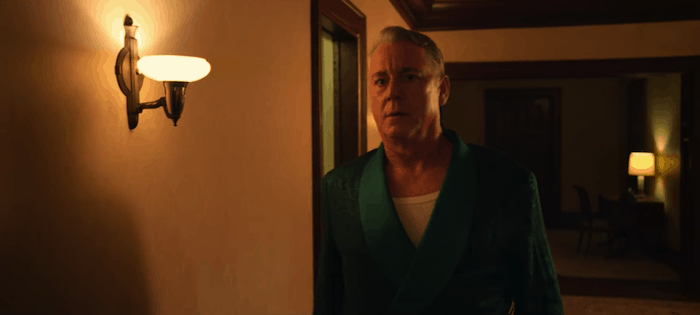
Dr. Hanover’s desperate desire to secure funding for his hospital makes him an easy target for Ratched’s machinations and his weakness to her is clearly established.
Initially angry at her for assuming an interview which he knows he nor anyone on his staff offered, her counter-anger and domineering presence immediately cows him and further attempts to raise this point are effortlessly brushed aside by her.
By the end; though he does not have the resources to offer her a job and makes this clear, he is apologising to her and indicating a willingness to consider her hiring if he could.
Preying on this, Ratched swipes nurse Emmerson’s purse; finding her home address and setting up her blackmail scheme.
Here, her yellow dress has shifted to red; showing her intelligence in appearing at multiple places in different clothes, so as not to be easily identified.
It also reflects her predatory nature, like a shark following a trail of blood; she is ready to strike. However, this is where the episode takes an unusual detour.
Returning to her motel, she makes a move that initially appears as a seduction to her hotel neighbour; yet quickly descends into a humourous roleplay of sorts.
She wants this man and herself to fight over children; with her finding them a burden, while his role is to want them.
However, the scene’s near farcical comedic tone shifts as she describes darker and darker details: They’ll divorce, she’ll realise she’s pregnant and be convinced to keep it; before his death and her abandoning of the child; now identified as a female.
On first viewing, this scene plays as a bizarre interruption to the blackmail intrigue; a broken personality either trying to re-create or cope with a form of trauma they’ve experienced.
As time goes on, the thought of her being Edward’s mother appears but unless she’s lying about the gender; this is impossible, leaving only two likely possibilities: Either she is talking about something she did to a character we have not met yet or she is describing her own life story.
Both possibilities are fascinating and the way that this interrupted all other focusses for her; albeit temporarily, was an intriguingly out-of-character moment for this hyper-focussed personality.
Learning the full details of this will be extremely interesting going forwards.
Once Ratched returns to the task at hand however, we get a short but intensely executed scene where the production-team are practically showing off at this-point.
The scene is 1 minute and 43 seconds long, yet has better production, costume and lighting design than many feature films.
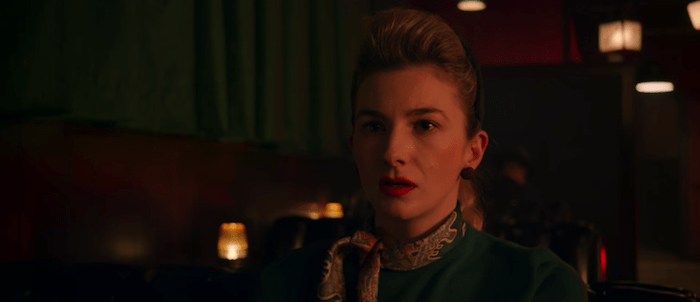
Green-bar lights and curtains, red lights to symbolise prey (Amelia) as she enters into the scene bathed by it, while red lighting surrounds Ratched as she exits; the predator continuing her hunt.
This scene is less a confrontation and more Ratched playing with her food.
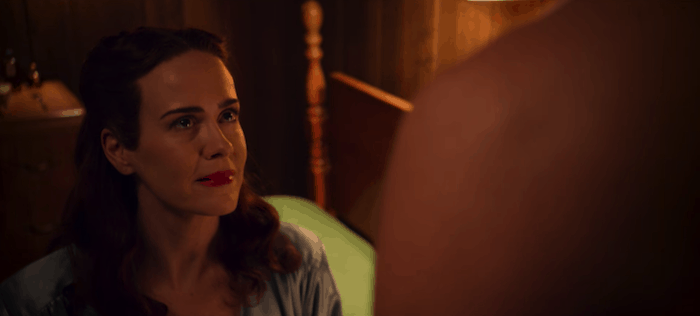
Her commanding presence makes Amelia take off her coat on command and Amelia’s dismal attempt to throw Ratched off: “Look I don’t know what you think you saw”, are countered by a simple: “Oh I know what I saw”.
It is delivered with such gentle rhythm and subdued malice, that it is shocking to think that this is Sarah Paulson’s first season in this role and not her fifth or sixth; given the effortless way she embodies this character.
When Amelia tries to act confident, saying dismissively: “What makes you think my husband will believe you?”, Ratched simply smiles; almost holding back a laugh.
Amelia immediately cracks in response to this, cowing to the demand for her to give up her job at the state hospital so Ratched can take it; the answer to why being obvious.
Amelia has shown up, that alone proves she is terrified of being exposed.
Both actresses nail the near-instantaneous collapse of Amelia’s resistance and the scene’s conclusion caps off this brilliant exchange perfectly.
Once Ratched has explained what excuse Amelia can use, the scene’s ambient bar music fades out and Mac Quayle’s score kicks in.
Ratched hands Amelia a toy doll and says simply: “For your daughter”; before exiting through a doorway bathed in red-light.
The connotations are obvious and the threat feels believable and exceptionally vicious, despite not a hand being laid on anyone.
All of this is achieved in a scene that is not even two-minutes long and indicates the level of time, love, effort and craftsmanship that went into every single second of screen-time.
It brilliantly displays Sarah Paulson’s acting range, yet is arguably not even in her top-three best moments of the episode and the story’s quality only increases from here onwards.
Immediately finding himself understaffed, Dr. Hanover receives a fruit basket from Ratched; fool’s gold or fruit in this case if ever I’ve seen it, that immediately causes him to remember and call for her help.
The episode then cements its mastery of its own visual motifs by repeating the hallway bathed in green light; only now Mildred Ratched is Nurse Ratched, wearing the blue uniform of the hospital and bathed in the green of sin.
It is a brilliant way to show the success of the first part of her scheme and from there, her manipulations ramp up at a lightning fast-pace.
As the governor visits and explores the facility, Ratched poisons an elderly patient; reducing his blood pressure with inappropriate medication, then ensuring she is the one to save him in front of the press and governor.
During this time, she also learns of another patient: Mr. Salvatore, who has been reduced to a near-catatonic state from grief; whose family do not want him let out from the facility.
From here, the pieces come together so smoothly that a Chess Grandmaster would be envious.
Firstly, Ratched is photographed with the patient she saved and the governor; ensuring her now permanent employment at the hospital, lest they fire their new public hero.
Secondly, she torments Mr. Salvatore in one of the episode’s highlight scenes; that truly establisher her as a master-manipulator and monster, yet with fascinating complexity.
In this scene, she opens up to Mr. Salvatore about parents she was taken away from and a brother she was separated from; in a truly phenomenal performance from Sarah Paulson, as her character’s vulnerability comes to the forefront.
Yet, what she encourages is truly horrifying: She leads him into killing himself; in order to escape a life trapped at this hospital, where nobody will ever truly care about him.
It is perhaps more disturbing than even the murders in the opening, as this is total exploitation of a vulnerable, innocent person; yet there are many layers to what this says about Ratched.
Clearly, she is ruthlessly single-minded, willing to go to any length; for a goal that will soon be shown and a genius-level psychological manipulator.
But, does she truly lack compassion? Was her entire story a ruse, to bait her victim?
Her own emotional control could suggest that, yet it felt exceptionally raw throughout and so a far more likely possibility; as well as far more disturbing, is that it was true.
Did she therefore manipulate him; not just as part of her plan, yet also to spare him a life that will lead him to become like her? If so, that is a truly disturbing display of externalised self-loathing and perverse ‘mercy’.
Soon enough, Dr. Hanover learns of her poisoning of the elderly patient; yet this is expertly countered by her within seconds, as the two of them find Mr. Salvatore’s body in his office bathroom.
Sent into a state of horrified shock, Hanover’s initial reason to confront her is completely forgotten and this is a recurring trend throughout the episodes.
At their first meeting, he is overwhelmed by her domineering presence.
At their second, he tries to speak to her; only to be pulled away by the governor, to reward him for a circumstance she created.
Now, his attention is completely pulled away yet again and in a moment of total weakness, she tells him what to do, say and secures herself a permanent position; simply by acting as an informal ‘cleaner’ for a mess she created.
Dr. Hanover is not; fundamentally, a bad person.
He is a constantly-stressed, socially progressive personality, in a world that in many ways is still not ready for it; fighting tooth-and-nail to get support.
Into this vulnerable state, has stepped a truly toxic presence in Mildred Ratched who has exploited the best of his nature and turned it into a fundamental weakness; via which to ensnare him.
His character bears no green clothing in this episode, in fact his office is largely dominated by blue; a welcoming and caring colour by this episode’s colour-connotations, yet I would not be surprised to see that change soon enough.
His unwillingness to face the consequences of his mistake has begun his own downfall; one way or another.
Ratched Season 1 Episode 1 ends on an intriguing cliffhanger that may well serve as a huge reveal already and certainly will in time.
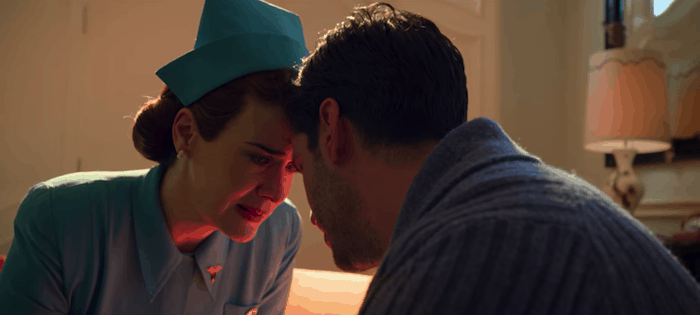
Edward Tolleson finally arrives at the facility and; once imprisoned in the converted wine-cellar now turned maximum-security wing, he comes face-to-face with Nurse Ratched.
Their reactions upon seeing each other are ones of familiarity and love, with Sarah Paulson selling this moment of emotional relief perfectly.
Given the level of cruelty we’ve seen her engage in within this story, this moment does not play as fake and so there is likely only one reveal this can be: It is her long-lost brother.
If so, watching Ratched’s schemes to free/save him; while hurting everyone else along the way, will be a fascinating emotional contrast and a fantastic look into the level of evil people are willing to sink to for those they love.
Here, the Ratched Season 1 Episode 1 ends and we are left with one of the strongest season premieres I have witnessed in a long-time.
While Finn Wittrock’s performance as Edward Tolleson hasn’t fully won me over yet; his performance feeling somewhat like a discount Thomas Hayden Church, the show hasn’t put a foot wrong practically anywhere else.
Ratched Season 1 Episode 1 delivers gorgeous production values, compelling mysteries; numerous intriguing elements and several standout scenes throughout, yet the greatest element by far is Sarah Paulson.
Her performance as Mildred Ratched is exceptional from her very first moment on screen, to the very last and if she was even half-as-good as this for the reason of the season; she’ll be a shoe-in for the awards ceremonies next year.
I cannot wait to watch the rest of this season and have no intention of doing so.
It is time for my latest binge of Netflix and no chill.
Let’s see where this goes.
Ratched Season 1 Episode 1 by Marley Eleven Bury
More Ratched Episode Reviews
Our Rating
Summary
A brilliant lead-performance from Sarah Paulson combined with exceptional storytelling and fantastic production values, make it one of this year’s television standout pilots. While the supporting cast are not quite her level, the show still boasts brilliant characters all round and sets up a brilliant season-long storyline.